Putnam Valley Historical Society
Preserving local history since 1968
Museum closed this weekend
The museum will be closed this weekend, June 20th & 21st and will reopen for regular hours on Sunday June 28th at 12:00PM. If you have already scheduled an appointment for this coming week, we will still see you at your scheduled date and time.
The Spirit of ’76 in ’26
In April 1976, as the United States of America was getting ready to celebrate the Bicentennial, The Putnam Valley Historical Society moved into the former Adams Corners Schoolhouse and opened the schoolhouse museum. The building has more or less been in use since its construction in the mid 1840s. After serving as the District 3 school in Putnam Valley, it was also proud to serve as the town library for one summer, a Red Cross donation center, the home of the Public Health Association of Putnam Valley & Kent for many years, and a nursery school.
Stepping back 50 years earlier to 1926, we have the first documented visit to Putnam Valley by none other than Babe Ruth. On August 21, 2026 it will be 100 years to the day since he was first photographed playing ball with neighborhood children near Lake Oscawana. Visit the museum during the month of August as we celebrate Babe Ruth in Putnam Valley month.
So what are we doing to celebrate our 50th Anniversary as well as the Semiquincentennial? We have a new historic marker recognizing Israel Putnam to install at Adams Corners this summer and will celebrate our anniversary at the unveiling of the marker. Another Lake Oscawana Boat Tour is planned for late summer. We’re organizing a long overdue historic cemetery project that will include identifying Revolutionary War veterans and last, but certainly not least, we’ll be inviting everyone to join us on October 3rd at Adams Corners from 12:00PM – 4:00PM as we step back in time to experience life during the American Revolution. We’ll have activities for folks of all ages at both the schoolhouse museum as well as the Putnam Valley Grange. Finally, we are reworking and moving up our annual Holiday Boutique to November. Until then, we’re open nearly every Sunday from 12:00pm – 4:00pm.
More recently, for the first time in many years, we welcomed students from Putnam Valley Elementary School! The third grade classes are coming over this week to explore the museum from front to back. They rotated through different stations and used slate & chalk to draw and work some math problems, saw a 149 year old schoolbook, held a cannonball, used a corn planter, identified some old buildings in photographs, looked at an 1867 map to see what one-room schoolhouse they would have gone to, saw a chamber pot (this was a huge hit), tried on some fancy hats, sat on a saddle and more. They’ve asked some very intuitive questions, made some astute observations, and left us feeling very inspired and enthusiastic about our plans for the future.


We look forward to welcoming you at the museum this year!
Valley Voices: A History Forum
Getting to know our community (again)
It has been quite some time since we’ve interacted with our community. Back when the world came to a screeching halt in early 2020, we lost our footing, momentum…our motivation. The heart has been there, the “oomph” was not. Slowly, it’s been coming back. The approaching 250th anniversary of the American Revolution is certainly helping, but so is the bit of nostalgia for how it used to be; Having exhibits that intrigue and draw visitors to the schoolhouse, hosting small events, and engaging with the residents of Putnam Valley.
Our first step is creating Valley Voices: A History Forum – a very casual, informal discussion group. Because of our limited space and accessibility, we are partnering with the Putnam Valley Library and will meet in their community room. It’s an opportunity to connect offline with fellow local history enthusiasts, share stories, and learn something new. We will also encourage you to bring any related photos, papers or objects to share. Think show-and-tell in kindergarten, but history related. Each time the group meets the historical society will provide the general topic, some relevant ephemera and documents for talking points and of course, the snacks. There will not be a dedicated speaker or presentation – the goal is to have local conversations in real time in addition to online and social media. You can come and go at any time during the discussion, or stay the whole time.
Our first forum will be on Saturday November 2nd from 2:00PM – 3:30PM at the Putnam Valley Library and will focus on the history of Lake Peekskill, which is coming up on it’s 100th anniversary in a few short years. We will bring some old maps and photos and newspaper clippings for you to look through. Are you a second or third generation resident? Newcomer to the area? Just plain interested in chatting with some familiar, neighborly faces and meeting some new ones? Join us at the library for what we hope will become a regular get together for our community.


Our next step is working to fulfill as many of the genealogy and house information requests we’ve been receiving via email as we can. Getting our files digitized (one page and photo at a time!) will make it far easier moving forward, but for now it is still largely a paper based document search. Keep an eye out for upcoming forums, we will probably have one devoted to the family trees of Putnam Valley at some point!
Live(ish) tonight at Tompkins Corners Cultural Center
Today is the opening night of the 2022 season of the Putnam Valley Residents Coalition Farmers Market at the Tompkins Corners Cultural Center (the old Tompkins Corners Methodist Church, 729 Peekskill Hollow Road). The Farmers Market runs from 3:00pm – 6:30pm and following the close of the market, there will be a double feature screening of two short documentaries:
A Tribute to Life on the Lake, a new short documentary about…well, just as the title declares, a tribute to life on Lake Oscawana and is based on a collection of historic postcards donated to the Putnam County Historian’s Office by David and Kathryn Bisbee and is narrated by our own town historian, Dan Ricci.
Fifty Miles From Times Square, a documentary by John Cohen from 1972 celebrates life here in Putnam Valley back in the early 1970s. Get ready to tap your toes during the square dance scenes!
Admission is free to the public – we hope to see you there! (Don’t forget to bring your reusable shopping bags to for all your farmers market purchases!
How Kramers Pond Road Got Its Name
Occasionally there’s a question of how a street or area in town got it’s name. After working on revising the town tours that were compiled over 30 years ago some of them have been easily answered – usually a family lived in the area (Crofts Corners), sometimes a geographical feature was added (Oscawana Lake Road), or an Anglicized version of a Native word was used (Canopus Hollow Road). Over the weekend found tucked away in a file cabinet was the answer to one of our local roads! The document itself is undated and was printed on a dot matrix printer, and based on the paper and the mention of a 90+ year old relative suggests it was written in the late 1980s or early 1990s. Read below to find out how Kramers Pond Road got its name and learn a bit about life in the country. In doing some additional research, it was found that Cornelius Kramers was listed as being born in Java on a draft card, some census records and his obituary, and other sources listed Holland. Either way, he traveled quite a distance to Putnam Valley!
How “Kramers Pond Road” got its name
By Joan Kramers Jackson, with contributions by her elderly cousin
Early in the 1900s Cornelius Kramers (from Holland) and Carolyn Fisher (from Switzerland) met on the boat which brought them to Ellis Island to make America their home. Fluent in English and French as well as their native tongues, they separated to pursue their respected occupations; he, to learn farming and she, to be a “governess”, teach French and give piano lessons.
In 1906 they married and in 1910, their search for a home brought them to a sparsely populated rural area called Putnam Valley which was seven miles from the small town of Peekskill, New York.
What a formidable endeavor for a young couple with a two-and-a-half-year-old son and an infant daughter to set down roots in an area where they knew no one! The simple farmhouse devoid of plumbing, central heat, phone, or electricity was on a narrow dirt road one-half mile from Oscawana Lake Road and the nearest neighbor. In addition to the house were thirty-five acres of land, meadows, fallow ground for gardening, woodland, orchards of peach, pear, and apple trees, and a shallow “spring” adjacent to the house for drinking water. A good-sized stream of clear sparkling water flowed swiftly through the acreage from Oscawana Lake three miles away. Previous owners had constructed a rustic dam, creating a good sized “swimming hole” (pond) and a waterfall which over the years was greatly enjoyed by countless friends and neighbors, not only during the hot summers but in the winter for skating as well.
Our home was named Oscawana Brook Farm and the post office address was RFD #2, Peekskill New York. Some years later (before 1920), when the valley’s population had grown considerably enough to warrant its own post office, the New York Telephone Company was ordered to connect Oscawana Lake Road telephone lines along our dirt road to Church Road. At that time, it had to be officially named to be placed on the map of the Town of Putnam Valley, and so it was recorded to this day, “Kramers Pond Road”, Putnam Valley, New York, the address of the many new homes built since 1910.
To my knowledge, we were (in 1910) the only “foreigners” living in the area. In the ensuing nine years, my father established a working farm, and four more children were born. His primary objective was raising poultry to sell fresh killed, and also to sell the eggs. Day old chicks were delivered by the mail carrier and immediately placed in a “brooder house” headed by a kerosene heater. Eventually, he bought a “Candee incubator” in which five hundred eggs were incubated. How interesting it was for us children to peer through the glass windows and see the eggs hatch! Cracking open one by one, wet baby chicks would emerge, very soon to be tiny active bundles of golden down feathers. Besides the flocks of chickens (of one thousand or more) we had a horse, several cows, a pig, and always a dog, and a cat or two. Consequently, we weren’t bothered by mice, and no rabbit or woodchuck dared venture into our vegetable gardens.
As soon as we were old enough to walk a mile to the one room schoolhouse (at the site of the present Town Hall), we, and perhaps fifteen other children, were prepped for later life by our beloved and devoted teacher, Miss Laura Mae Russell. Oregon Corners and Adams Corners each had their own one room schools, which not until 1935 were consolidated into the Putnam Valley School System. Our religious education began much earlier, since it was impossible for my mother and five small children to attend the Methodist Episcopal Church of Putnam Valley. Each Sunday after breakfast the family gathered in the living room where mother instilled in us the love of the Bible and played the hymns which we are all still singing in our respected churches. What an invaluable heritage our parents left us!
At home, we were all taught to assist with chores of daily living; trees to cut (fuel for two stoves) – later coal was used also, wood to chop, carry and stack; livestock to tend; gardens to sow, weed and eventually harvest; hay to make; butter to church; and oil lamps to be filled, wicks cut, and chimneys washed. Mother canned, peeled and cut peaches, apples and pears; putting them on wire screens in our very hot dry attic. Later she placed them in unbleached muslin bags and stored them for winter use. She did all her own baking, countless loaves of bread, rolls, pies, and cakes (with no icing as sugar was so scarce during the war). She made her own jam and jelly, grape, blueberry, wild strawberry, and apple butter. Our cows kept us well supplied with milk and butter which we churned by hand.
On Saturdays, my father went with horse and wagon to Peekskill to sell his eggs, chickens, plus any other produce, and to buy staples. We avidly read the Saturday Evening Post (our only magazine) and selected whatever wearing apparel mother couldn’t make for us from the “wishing books”, Sears Roebuck and Montgomery Ward catalogues. Mother was an indefatigable knitter; she bought raw wool from a farm in New England and knitted all our winter outdoor clothing (mittens, hats, scarves, sweaters, and stockings). During the winter, when ice on the pond reached a thickness of 14 inches, my father would saw large squares and put them on the horse drawn “stone boat”, where they were stored, covered with thick layers of saw dust in between to sell in the summer to those who had ice boxes.
It has been a distinct pleasure for me to share this information, collaborated by my devoted cousin now ninety-two years of age, who visited us coming on horseback from her home in Cornwall on Hudson where she was a “farmerette” in World War I.
The farm was sold in the 1930s to Dr. Zazzuli, dentist.
History Hikes
Our esteemed town historian Dan Ricci will be leading a hike through Fahnestock this Saturday October 30th with Cassie Ward, the executive director of the Putnam History Museum. Registration is required, see the link below. If you’ve never been out by Sunk Mine Road and into the woods…it’s definitely worth checking out! Wear your hiking shoes and comfy clothes, it’s a full day in the mysterious mine country of Putnam Valley.
http://www.putnamhistorymuseum.org/eventsmc/phm-history-hike-series-fahnestock-state-park/
We’re Baaaaaaack!

It’s been quite a while! In 2018 and 2019 BCE (before Covid era) we had Our American History, we had visitors at the museum, we had local history outings….and then suddenly we didn’t.
To mark the start of our comeback, we invite you to join us as we offer you a day of historical society fun, cramming a whole year into a few hours. Being mindful of everyone’s safety, we’ve decided to bring it outside. Primarily as a social distancing measure but also because the capacity in the schoolhouse is less than 30 people, and we want to see WAY more than 30 people. We’ll have our annual meeting, a larger than life yet at the same time fun sized edition of Our American History, handmade crafts that you normal see at our holiday boutique, and more.
Bring a picnic lunch or step on up to the food truck for your lunchtime needs (starting at 12:00PM) and if you could go for something sweet afterwards, we’ll have that too. Do a little early holiday shopping while supporting your friends and neighbors, and most importantly enjoy a beautiful fall day in the park. We’ll see you there!
That Old House
Help us save this house!
Every town has an old house. That older house, tucked away in plain sight that’s always been there. Sometimes they date back to the mid 1800s and occasionally the early 1800s. There are a few in our parts that are even older. They are members of an elite group; they are few in number but huge in importance. They have seen the signing of the Declaration of Independence, the birth of the United States of America.

A man by the name of Abraham Smith made his way up from Long Island to (upstate) New York, where he settled and built his home on a tract of land that later came to be known as Smith’s Corners, or Smith’s Four Corners. It is the large old house on the northeast corner of the intersections of Bryant Pond Road, Secor Road, and Wood Street right at the very edge of Putnam Valley, just off the Taconic State Parkway. It is also generally accepted to be one of if not the oldest structure in Putnam Valley, with an estimated built date of 1723 – 1747. The Smith family was a tenant of Beverly Robinson’s, and it was only after the land was confiscated and sold that the family obtained a deed from the Commissioners of Forfeitures. In layman’s terms – the Smith family built their home on land that was part of the Philipse Patent, and had to pay rent to Beverly Robinson. The house predates the United States of America, the State of New York, Putnam County and the Town of Putnam Valley. The Smiths were among the first settlers in the area.
The Smith family wasn’t exactly the type to settle into just farming as so many of the early settlers here. Abraham’s son Abraham Jr. was said to have been, at the age of 22, the youngest justice ever appointed in New York State. He was a supervisor of Philipstown and a judge in Putnam County. He was also the president of the Putnam Valley Bank, which operated out of the house from 1849 until his death in 1854. If you do a Google search for Putnam Valley Bank, an auction site comes up with a past lot that included a $2 note issued by the bank. Sadly, we do not have any original notes in our collection.
It is Abraham Jr.’s young brother Saxton Smith however, that was more known in Putnam Valley. During his impressive career as a public servant he served as Superintendent of Schools, the Commissioner of Deeds, Town Supervisor (for a record number of years, surpassed only by one Mr. Harry Silleck), a member of the NYS Assembly and as a NYS Senator.
Between the two brothers, they settled thousands of estates in Putnam County and the town.
During the Smith’s ownership, the house was host to several notable people of the time including “Seward, Weed and Greely, Governor Silas Wright and Horatio Seymour and Hon. Chauncey M. Depew” (Fishkill Standard, 25 May 1900)
Saxton was the last of the Smiths to live in the house. After his death in 1890, a niece of Saxton sold it to Reuben Gilbert in the mid-1890s.
This integral part of Putnam Valley history is at risk of being lost forever. There is a chance it will be torn down in the not too distant future for a commercial endeavor. We need your support in saving this house. Having been afforded the opportunity to tour the property a few weeks ago, it certainly needs work but can be an invaluable asset to both our town and county. The first step though, is getting your support. Please click the link below or at the top right to complete a very simple survey after reading about the property.
2020 Annual Holiday Boutique Cancelled
With the health and well-being of our members, holiday shoppers, and the community – we have decided to cancel our annual holiday boutique for this year. We simply don’t have adequate indoor space or appropriate ventilation at the schoolhouse for social distancing, we can’t hold it outside on the grounds, and with the uncertainty of whether or not we’ll be headed towards another partial shutdown it wouldn’t be fair to the vendors, our visitors or ourselves to have everything set up only to find out at the last minute we couldn’t open. Hopefully by this time next year you’ll be seeing our signs roadside advertising the boutique but this year – please shop local when you can, support your neighbors and local craftspeople – and stay safe.
Historical Markers and Signage
Everybody has seen them driving around the area, but do you actually stop and read them? Most commonly you see the blue and gold signs, with a quick paragraph about the area in the general proximity of the marker. They’re easy enough to read if you’re stopped at a light or riding as a passenger, but some are off the main roads. We don’t have too many here in Putnam Valley (some of the photos below are of the same sign from different angles or a closer position) but we want to know – where else do you think is deserving of a marker? There’s been an increase in interest of the old driving tours of Putnam Valley, and we’ve recently decided to take another look at revamping/reorganizing the tours into a more complete look at the town. A perfect socially distancing way of spending an afternoon – and this is definitely a more down the road (haha!) project but we’ll be asking for volunteers to help pull it together, so keep an eye out here and on Facebook for more information!
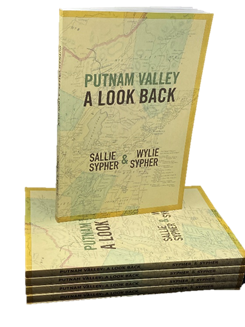
Putnam Valley: A Look Back
I'm local to Putnam Valley and am buying my book in person!
$25.00
Putnam Valley: A Look Back
I don't live near Putnam Valley but would still love a copy - please mail it to me!
$30.00